When the Queue Becomes the Campaign
How Yogiberry's revival of a familiar experience is bringing generations together — and turning customers into one of its most visible marketing channels.
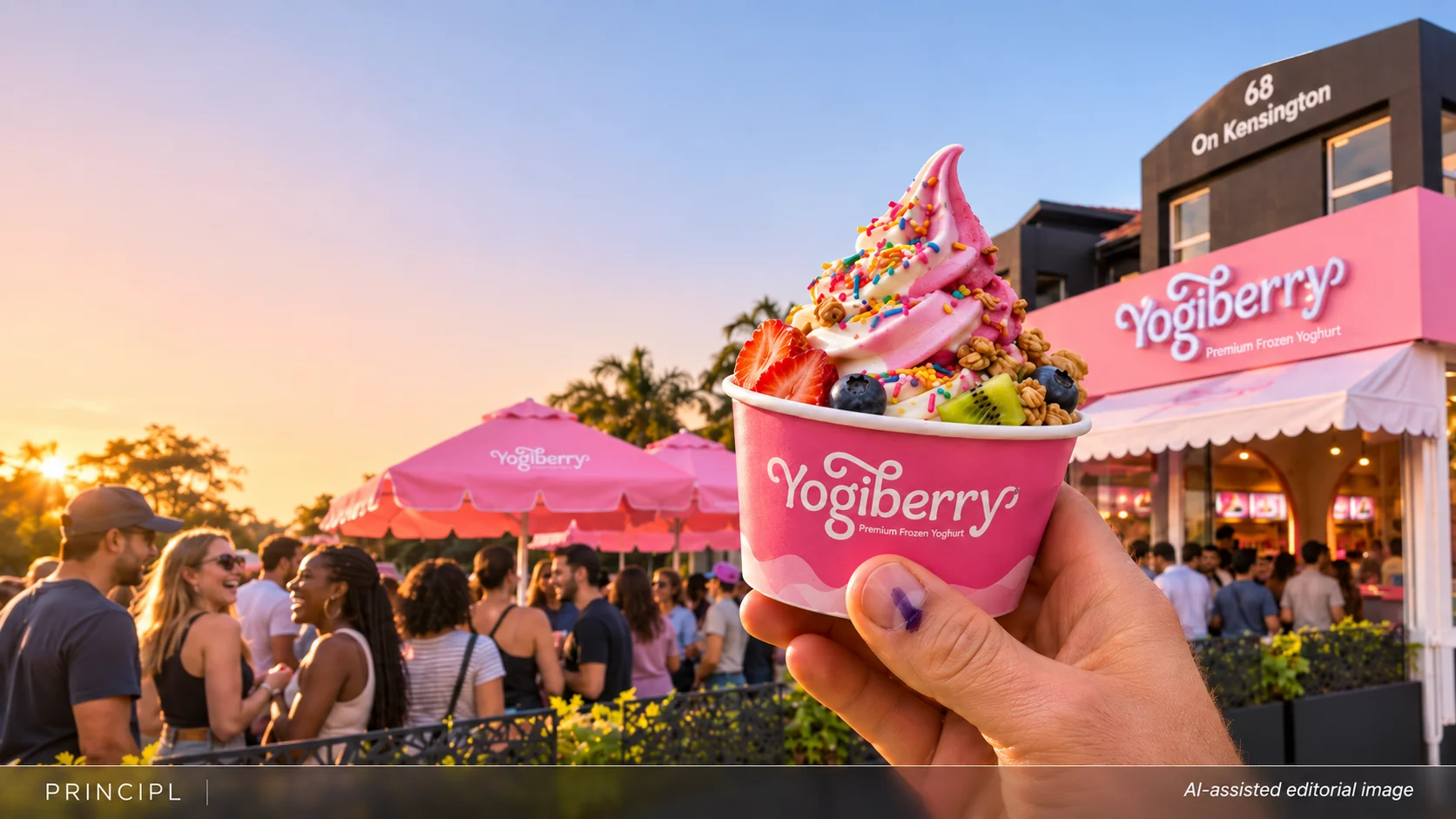
Something interesting is happening outside Yogiberry.
Every second Saturday, I find myself passing two Yogiberry stores: one at Westville Mall and the other in Durban North.
And since they've opened, I've noticed a recurring pattern.
The queues.
Groups of friends chatting excitedly. Teenagers and young adults gathering. Parents bringing their children. A palpable sense of anticipation that spills beyond the storefront and into the surrounding shopping spaces.
But the thing that interests me most isn't the queue itself.
It's what people are doing while they wait.
Phones are out. People are filming the crowds, recording reels, taking photographs and sharing the moment.
They're documenting the experience before they've even bought the product.
And it got me thinking.
What happens when a queue stops being just evidence of demand and starts becoming part of what attracts more people?
Because that's what I suspect we're witnessing.
A situation where customers aren't simply buying a product.
They're helping make the brand more visible to everyone around them.
An old experience finds a new audience
For anyone who remembers Wakaberry, there's something familiar about what's happening.
Launched in Durban in 2011, Wakaberry helped popularise self-service frozen yoghurt in South Africa. Customers could choose their flavours, add toppings and create something entirely their own.
The brand expanded quickly before the category lost momentum. By September 2024, its last remaining South African outlet had closed.
Now, in 2026, frozen yoghurt is back in the spotlight.
Yogiberry launched in May within the Pedros business environment and has since expanded into standalone locations, including Westville Mall and Durban North.
Importantly, Yogiberry isn't Wakaberry reopening. It's a separate, new brand bringing a familiar product experience back into popular culture.
And I think that familiarity creates an interesting possibility.
Watching parents bringing their children to Yogiberry, I can't help but wonder whether nostalgia is playing a role.
For some parents, self-service frozen yoghurt may bring back memories of a trend they experienced more than a decade ago.
For their children, it may feel entirely new.
Nostalgia for the parents. Discovery for their children.
I haven't interviewed these families, so I can't claim nostalgia is why they're visiting. But the potential overlap between generational familiarity and modern social-media culture is interesting.
What was once a popular retail experience is being introduced to an audience that doesn't just participate in trends.
It documents them.
And that changes the way excitement can spread.
The queue is becoming content
The Social-Proof Flywheel
Conceptual illustration of a potential reinforcing cycle. Not measured Yogiberry customer acquisition data.
We've all experienced the influence of social proof.
When we encounter something unfamiliar, we often look at what other people are doing to help inform our decisions.
A busy restaurant can appear more appealing than an empty one. A product with enthusiastic recommendations can feel less risky than one nobody is talking about.
A queue sends a particularly visible signal.
People are willing to invest their time to experience something.
It doesn't prove the product is exceptional. It doesn't prove the business is profitable.
But it does communicate popularity.
At Yogiberry, that signal appears to be travelling beyond the physical store.
The queues are being photographed and filmed. Those images are shared through personal social networks, potentially introducing the experience to people who haven't visited.
Someone scrolling through Instagram sees a friend at Yogiberry.
Then another story appears.
Then a reel showing the queue.
The experience starts to feel familiar before they've even tried it.
And curiosity can become a desire to participate.
This creates the possibility of a powerful feedback loop:
Visible demand → customer content → social curiosity → new visits → more visible demand.
The important word here is possibility.
We don't have Yogiberry's customer acquisition data or the ability to attribute sales to individual social posts.
But we can observe the conditions that might allow that loop to develop.
And there is evidence that customer-generated content is part of Yogiberry's early momentum.
In an October 2026 interview with Time Out Durban, Yogiberry's leadership described customers photographing their creations, posting online and bringing friends along.
What I've been witnessing at Westville Mall and Durban North appears consistent with that wider pattern.
FOMO isn't always about the product
I suspect fear of missing out is another part of the story.
But there may be several different motivations operating at once.
There's the fear of missing the trend.
When something repeatedly appears in your social feed, it can create curiosity about why everyone seems interested.
There's the fear of missing the social experience.
Going to Yogiberry with friends becomes an outing. Something to do together, experience together and talk about afterwards.
And there may be an element of nostalgia.
For some people, the return of a familiar dessert experience could carry an emotional appeal beyond the product itself.
These motivations don't need to be mutually exclusive.
Someone might visit because their friends are going, discover they enjoy the product and return for an entirely different reason.
This is where the distinction between attention and lasting customer value becomes important.
The reason someone tries a brand for the first time isn't necessarily the reason they keep choosing it.
Customers are doing some of the storytelling
Businesses spend enormous amounts of time and money trying to generate conversations about their brands.
We create campaigns, develop content calendars, collaborate with influencers and look for ways to encourage sharing.
But sometimes the most interesting brand communication isn't produced by the business.
It's created by the customers.
Yogiberry's experience gives people several things worth sharing.
The product is visual and customisable. Customers take part in creating it. Visiting is often a social activity. And the queues themselves provide a conspicuous signal that something is happening.
The result is an experience with multiple opportunities for customers to create content.
What's particularly interesting is that the content isn't always about the frozen yoghurt.
Sometimes it's about the crowd.
Sometimes it's about being there.
Sometimes it's simply an opportunity to say, I finally tried it too.
That is a different kind of communication from a conventional product advertisement.
The brand can tell people what it offers.
But customers can show other people what it feels like to participate.
We shouldn't underestimate that distinction.
Nor should we assume it happened entirely without deliberate brand-building. Yogiberry has its own marketing activity, and its leadership describes social sharing as an important part of the experience.
The interesting relationship is between the experience the business creates and the visibility customers voluntarily generate around it.
The real test comes after the hype
There's another side to the story.
Long queues may generate attention, but they can also create frustration.
Novelty can encourage first-time visits, but it doesn't guarantee repeat purchases.
And social-media popularity doesn't automatically become a sustainable business.
Wakaberry's history is a reminder that enormous early excitement and widespread recognition aren't necessarily enough to sustain a brand indefinitely.
For Yogiberry, the more revealing question isn't whether customers are excited today.
It's whether they'll continue visiting once the experience becomes familiar.
Will the product consistently meet expectations?
Will the experience remain enjoyable?
Will customers return without needing the motivation of a social trend?
Hype creates an opportunity to win attention. Consistency creates an opportunity to earn loyalty.
That's an important distinction for any business experiencing rapid growth.
Attention can accelerate trial.
But the experience must ultimately justify the attention it receives.
Five lessons other businesses can take from this
Yogiberry is a consumer-facing food business, but the underlying principles extend well beyond frozen yoghurt.
1. Create something worth sharing
Before asking how to encourage customers to post about your business, consider what makes your experience genuinely worth talking about.
A memorable interaction, a thoughtful service detail or a result that exceeds expectations can become a reason to recommend a business.
2. Understand the emotional side of customer decisions
People don't make every decision based solely on practical benefits.
Curiosity, belonging, familiarity, confidence and shared experiences can all influence what they choose.
Understanding those motivations can reveal opportunities that product-focused marketing might miss.
3. Let customers participate
People are more likely to feel invested in experiences they help shape.
That doesn't mean every business needs self-service machines or customisable products.
It means looking for meaningful opportunities to give customers choice, involvement or a sense of ownership.
4. Recognise that customer experience extends beyond the transaction
The experience starts before someone buys and continues after they leave.
What people hear about your business, what they see others doing and what they tell their friends all contribute to how the brand is perceived.
Customer experience and marketing aren't separate activities.
They influence one another.
5. Build for the second visit, not just the first
Getting attention is one challenge.
Giving customers a reason to return is another.
Businesses should be as deliberate about meeting expectations, improving delivery and encouraging repeat behaviour as they are about attracting new customers.
The PRINCIPL perspective
I keep coming back to those queues.
Not because frozen yoghurt is revolutionary.
And not because Yogiberry has necessarily discovered a new marketing technique.
But because the activity around the brand illustrates something that businesses sometimes overlook.
Customers don't experience brands in isolation. They experience them socially.
Their expectations are influenced by what they see.
Their decisions can be influenced by what other people do.
And their experiences contribute to the stories other people hear.
Yogiberry offers an interesting example of how visible demand, shared experiences and customer-created content might reinforce one another.
Whether that translates into lasting brand equity remains to be seen.
But there's already a useful question for businesses of every size:
Are you giving customers something worth talking about, or are you relying entirely on your own marketing to tell the story?
Because sometimes the most compelling marketing isn't the campaign a business launches.
It's the conversation its customers start.
Sources and further reading
- Time Out Durban — What's behind the Yogiberry buzz in Durban? (9 October 2026)↗
- BusinessTech — Goodbye Wakaberry (18 September 2024)↗
- Yogiberry — Official website↗
PRINCIPL Brand Observations explores real-world business behaviour through the lens of brand strategy, customer experience and growth. This independent analysis is based on recurring personal observations and publicly reported information. Interpretations of customer motivations and marketing effects are presented as hypotheses, not measured findings. PRINCIPL has no commercial relationship with Yogiberry or Wakaberry.
Looking at your business from a different perspective?
At PRINCIPL, I help businesses understand where they're getting stuck, what their customers value and which changes are worth making.